
Popular on Rezul
- Still Using Ice? FrostSkin Reinvents Hydration - 128
- Volarex Named Chartered Consultant of the Year at Business UK National Awards
- Mend Colorado Launches Revamped Sports Performance Training Page
- Cold. Clean. Anywhere. Meet FrostSkin
- Ice Melts. Infrastructure Fails. What Happens to Clean Water?
- Actor, Spokesperson Rio Rocket Featured in "Switch to AT&T" Campaign Showing How Customers Can BYOD and Keep Their Number
- Novestco Revolutionizes Deal Screening, Delivering Comprehensive Feasibility Analysis in Minutes
- The World's No.1 Superstar® Brings Disco Fever Back With New Global Single and Video "Disco Dancing"
- Boston Industrial Solutions' Natron® 512N Series UV LED Ink Achieves BPA Certification, Advancing Safe and Sustainable Digital Printing
- New Children's Picture Book "Diwa of Mount Luntian" Focuses on Calm, Culture, and Connection for Today's Families
Similar on Rezul
- CCHR: While Damaging Antipsychotics Win Approval, Proven Non-Drug Alternatives Remain Ignored
- Vesica Health Receives FDA Breakthrough Device Designation for AssureMDx
- Lineus Medical's SafeBreak® Vascular Added to Alliant GPO Contract
- Gigasoft Solves AI's Biggest Charting Code Problem: Hallucinated Property Names
- CCHR Says Psychiatry's Admission on Antidepressant Withdrawal Comes Far Too Late
- CCHR: Decades of Warnings, Persistent Inaction; Studies Raise New Alarms on Psychiatric Drug Safety
- General Relativity Challenged by New Tension Discovered in Dark Siren Cosmology
- The Quasar Dipole Phenomenon is likely just a complex systematics artifact
- CCHR: Taxpayer Billions Wasted on Mental Health Research as Outcomes Deteriorate
Hubble Tension Solved? Study finds evidence of an 'Invisible Bias' in How We Measure the Universe
Rezul News/10727614
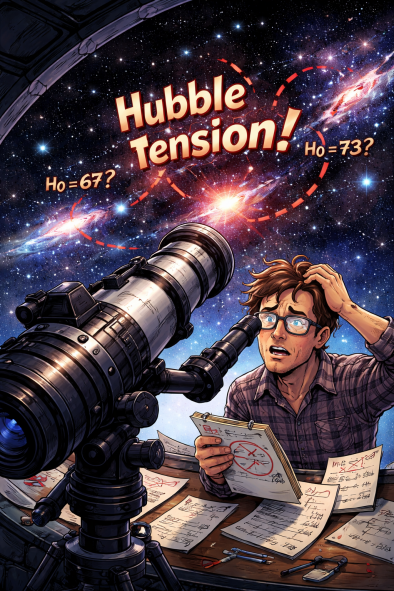
A newly published analysis proposes that the famous "Hubble tension" likely stems from an inference bias, occurring when standard General Relativity is applied to gravitational wave data that actually follows modified propagation.
HONOLULU - Rezul -- The long-standing "Hubble tension"—a discrepancy between early-universe measurements of cosmic expansion and late-universe distance measurements—remains one of modern cosmology's most debated puzzles. While the discrepancy is often interpreted as evidence for new physics in the universe's expansion history, a new study proposes a different possibility: part of the tension may arise from how distances are inferred.
In a recent implications analysis, independent researcher Aiden B. Smith examines whether gravitational-wave distance measurements—specifically from so-called "dark sirens"—could be subtly affected by assumptions about how gravitational waves propagate across cosmological distances.
More on Rezul News
Dark sirens are gravitational-wave events without confirmed electromagnetic counterparts. Their distances are inferred statistically using galaxy catalogues. Smith's analysis uses his previously identified propagation anomaly in the GWTC-3 dataset as a template and asks: if gravitational-wave amplitudes decay slightly differently than predicted by General Relativity, what effect would that have on cosmological inference?
The study finds that, under this hypothesis, applying standard General Relativity during distance compression can induce a shift in the inferred Hubble constant of approximately +2 to +5 km/s/Mpc—comparable in scale to the observed tension.
Importantly, the paper does not claim to resolve the Hubble tension. Instead, it demonstrates that gravitational-wave propagation assumptions are not mathematically neutral: if even modest deviations are present, they can bias late-time inferences.
The modified-propagation preference identified in the GWTC-3 dark-siren sample has been subjected to internal calibration and stress testing, including injection-based null simulations and robustness checks against selection and catalog perturbations. While the signal remains statistically unusual within the tested framework, confirming its physical origin will require independent replication and larger gravitational-wave samples from future observing runs.
More on Rezul News
If confirmed, the results would suggest that part of the Hubble tension may reflect a subtle distance-inference effect rather than a fundamental breakdown of the expansion model itself. If not, the analysis provides a quantitative diagnostic of where dark-siren cosmology may be vulnerable to systematic effects.
The full study and reproducibility materials are publicly available.
Data and Study Availability: While the work is currently in peer review, the full study is available to read on Smith's research journal at quasardipolephenomenon.org. All code and reproducibility artifacts associated with this analysis can be downloaded via Zenodo (DOI: 10.5281/zenodo.18635659) or accessed on GitHub.
In a recent implications analysis, independent researcher Aiden B. Smith examines whether gravitational-wave distance measurements—specifically from so-called "dark sirens"—could be subtly affected by assumptions about how gravitational waves propagate across cosmological distances.
More on Rezul News
- Wayne Homes Empowers Homebuyers with Free Interactive Floor Plan Builder
- ConnectNeighbors.com Joins WeSERV REALTOR® Association as Affiliate Member
- Claude Riveloux Review 2026: How the $10B Fund Manager Dispels 'Scam' Rumors Through Education
- Pure Energy Electrical Services, LLC Announces Strong Start to 2026, Reinforcing Customer-First Electrical Service Across Northeast Florida
- Danholm Collection Launches Boutique Luxury Real Estate Brokerage in Central Florida
Dark sirens are gravitational-wave events without confirmed electromagnetic counterparts. Their distances are inferred statistically using galaxy catalogues. Smith's analysis uses his previously identified propagation anomaly in the GWTC-3 dataset as a template and asks: if gravitational-wave amplitudes decay slightly differently than predicted by General Relativity, what effect would that have on cosmological inference?
The study finds that, under this hypothesis, applying standard General Relativity during distance compression can induce a shift in the inferred Hubble constant of approximately +2 to +5 km/s/Mpc—comparable in scale to the observed tension.
Importantly, the paper does not claim to resolve the Hubble tension. Instead, it demonstrates that gravitational-wave propagation assumptions are not mathematically neutral: if even modest deviations are present, they can bias late-time inferences.
The modified-propagation preference identified in the GWTC-3 dark-siren sample has been subjected to internal calibration and stress testing, including injection-based null simulations and robustness checks against selection and catalog perturbations. While the signal remains statistically unusual within the tested framework, confirming its physical origin will require independent replication and larger gravitational-wave samples from future observing runs.
More on Rezul News
- Sellvia Market Expands Curated Store Portfolio for Dropshipping Sellers
- The New Real Estate "Just Looking" Program Is A Big Hit With Northern Utah Area Residents!
- Food Journal Magazine Raises the Standard for Restaurant Reviews in Los Angeles
- Diversified Properties Closes on Brookside at Montville, Advancing Plans for Premier 55+ Community
- Williamsville Spa Expands Team to Meet Growing Demand for Professional Facials
If confirmed, the results would suggest that part of the Hubble tension may reflect a subtle distance-inference effect rather than a fundamental breakdown of the expansion model itself. If not, the analysis provides a quantitative diagnostic of where dark-siren cosmology may be vulnerable to systematic effects.
The full study and reproducibility materials are publicly available.
Data and Study Availability: While the work is currently in peer review, the full study is available to read on Smith's research journal at quasardipolephenomenon.org. All code and reproducibility artifacts associated with this analysis can be downloaded via Zenodo (DOI: 10.5281/zenodo.18635659) or accessed on GitHub.
Source: Aiden Blake Smith
0 Comments
Latest on Rezul News
- Memelinked Social Media powered by cryptocurrency launching July 2026
- Colliers represents seller in sale of 34,430-square-foot office building in Sugar Land, Texas
- Maui Luxury Real Estate Agents Share Fun Ways to Stay Active on Maui!
- Seven-Year-Old Toronto Dancer Julianna Selivanov Wins Nine Medals at Quebec Championship and Reaches Finals at UK Dance Festival
- PulteGroup expands Northeast Florida presence with Seminole Palms and Lakeview Estates
- JiT Home Buyers Provides Guidance for Families Navigating Inherited Homes Nationwide
- Progressive Dental & The Closing Institute Partner with Zest Dental Solutions to Elevate Full-Arch Growth and Patient Outcomes
- The Real Estate Ecosystem Built for You
- Spring Surge in 55+ Communities: What Buyers and Sellers Need to Know in 2026
- Jason Caras Launches The Caras Institute Following Successful Exit from IT Authorities
- Serina Damesworth Hired as Century Fasteners Corp. – Director of Quality
- JiT Home Buyers Emphasizes Transparency and Clear Communication in Direct Home Sales Nationwide
- National Expansion Ignited Across Amazon $AMZN, Chewy $CHWY & Walmart $WMT: NDT Pharmaceuticals, Inc. (Stock Symbol: NDTP) $NDTP
- Buying Islamorada Luxury Real Estate: What You Need to Know
- Distributed Social Media - Own Your Content
- Tarrytown Expocare Pharmacy Announces Strategic Leadership Appointments to Accelerate Growth and Innovation
- New Environmental Thriller "The Star Thrower" Reimagines a Classic Lesson in Individual Impact
- Summit Appoints Javier Cabeza as Data, AI, and Analytics Practice Lead
- Providence Group Realty Champions the Next Era of Independent Brokerage in Texas
- March Is Skiing's Smartest Buying Window